Strengths
Concise Writing: From the beginning, the study stands out for its clear and concise writing throughout the Abstract’s introduction, method, results, and conclusion. This briefness assures that readers can easily understand the research’s objectives, approaches, and results without excessive intricacy. The paper lacked much of the medical jargon I was expecting and, instead, the medical research mentioned was explained understandably.
Building on Previous Research: One of the study’s strengths is how the author references another study and its findings to establish footing for its research. By recognizing previous work and explaining how their study builds upon it, the authors effectively illustrate their contributions and underline the importance of their work.
Structured Categories: The paper is well-organized, especially in the characterization revolving around the elements of patient life experience. The four key areas explored are diagnosis acceptance, future life conceptualization, responses to treatment options, and the impact of race/ethnicity, social class, and gender providing a comprehensive framework. This organized system aids in addressing the varied experiences of patients with early-stage Parkinson’s disease.
Community Impact: The authors also explain the potential impact of their research on the community. By providing insights into the social and household contexts of early-stage Parkinson’s disease, the study presents useful knowledge for enhancing patient care. This practical application highlights the relevancy of the research to physicians, patient organizations, and family members, as its goal is to better the quality of care and aid for patients.
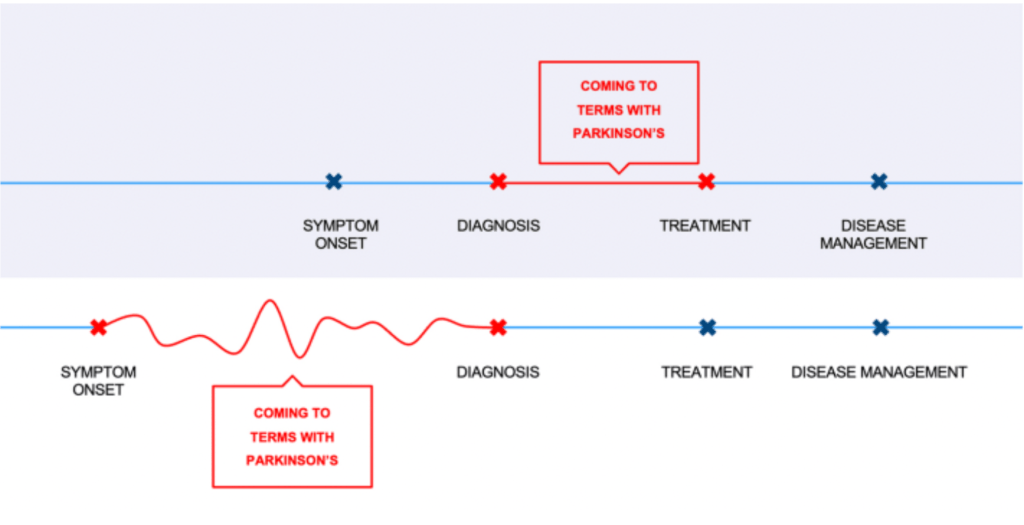
Effective Use of Diagrams: The way the authors used their diagrams is another unique strength. These visual assets help to illustrate difficult concepts and data, making the information more engaging for readers.
Example:
Weaknesses
Repetitive Summary Sections: A weakness I noticed in the study is the redundancy of the key summary points and the plain language summary. Both sections nearly repeat the same information, which is unnecessary. Combining or removing these sections could improve the overall clarity and conciseness of the paper. However, I understand that the journal this research paper was published may have set requirements for the formatting of the paper, leading to redundancy which in that case I understand.
Interview Focus: While the study includes thorough interviews with individuals with Parkinson’s, their families, and healthcare practitioners, this process may have disadvantages. As the primary goal of this research is to understand “how the clinical features of early-stage Parkinson’s disease become meaningful to patients in their social contexts, focusing exclusively on patients and their family members,” including healthcare practitioners introduces additional data points that do not directly align with the research goal, potentially weakening the focus.
Use of wording: The study also claims to uncover how hidden factors such as attitudes, beliefs, and social structures shape the patient experience. I do believe that these factors shape patient experience and although they may be overlooked elements, the use of the word “hidden” throws me off as I don’t feel as though they are hidden, they just have not been looked for.
In conclusion, “An Ethnographic Study of Patient Life Experience in Early-Stage Parkinson’s Disease in the United States and Germany” by Todd Carmody et al. is a well-structured investigation of the patient experience. While the study thrives in its clearness, organization, and practical relevance, it could benefit from reducing redundancy in its summary sections and narrowing its interview focus to better align with its primary research objectives.
 Anthrofusion
Leave a comment